

Travel Subscription Models: The New Opportunity for Agencies

For years, most travel agencies have relied on one-time bookings and commissions, making revenue unpredictable. Subscription-based travel models offer recurring income and stronger customer loyalty.
Agencies can offer members exclusive discounts, perks, flexible deals, or premium services through recurring plans. With travelers seeking convenience and value, subscription models present significant growth opportunities for agencies.
What Is a Travel Subscription?
A travel subscription is a recurring fee—usually billed monthly or annually—that a travel business charges in exchange for ongoing access to discounts, exclusive deals, cashback, or premium services. Unlike a one-time booking, the customer keeps paying (and the agency keeps earning) whether or not they travel that month.
It helps to think of travel subscriptions as falling into two broad categories:
- Trip subscriptions — the customer pays a fixed fee and receives an actual trip, flight, or stay as part of the package (think Wizz Air’s Multipass, which bundles a set number of flights into a monthly fee).
- Membership clubs—the customer pays a fee purely for access: discounted rates, cashback, priority support, or exclusive deals, without a guaranteed trip attached (think AAA or Tripadvisor Plus).
This is meaningfully different from a traditional loyalty or points program, where customers earn rewards only after they’ve already spent money. A travel subscription flips that order — the customer commits first, and the value (and the agency’s recurring revenue) flows from there.
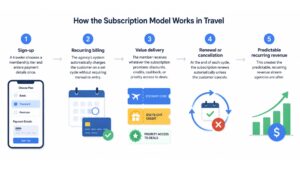
How the Subscription Model Works in Travel
Understanding how the subscription model works in practice helps clarify why it’s so different from the booking-by-booking grind most agencies are used to.
The Basic Mechanics
- Sign-up – A traveler chooses a membership tier and enters payment details once.
- Recurring billing – The agency’s system automatically charges the customer on a set cycle (monthly or annually) without requiring manual re-entry.
- Value delivery – The member receives whatever the subscription promises: a discount code, a free monthly flight credit, cashback, or priority access to deals.
- Renewal or cancellation – At the end of each cycle, the subscription renews automatically unless the customer cancels, which is what creates the predictable, recurring revenue stream agencies are after.
Trip Subscriptions, Membership Clubs, and Travel Memberships Compared
It helps to draw a clear line between three things that often get blurred together: trip subscriptions, membership clubs, and traditional loyalty programs. The first two are both paid forms of travel membership; the third is free and works on a completely different logic.
| Aspect | Trip Subscriptions | Membership Clubs | Loyalty / Points Programs |
| Cost to join | Paid (recurring fee) | Paid (recurring fee) | Free |
| What the customer gets | An actual flight, stay, or trip credit each cycle | Discounts, cashback, or priority access — no trip guaranteed | Points that accrue after spending |
| When value is delivered | Every billing cycle | Every billing cycle | Only after the customer books and spends |
| Example | Wizz Air Multipass | AAA, Tripadvisor Plus | Airline frequent flyer/hotel points programs |
| Revenue for the agency | Direct recurring revenue | Direct recurring revenue | None directly—a retention cost |
| Agency complexity | Higher (inventory must be allocated) | Lower (mostly discount logic and billing) | Low, but ongoing point-tracking overhead |
| Best for | Frequent, predictable travel patterns | Occasional travelers who still want savings | Rewarding existing bookers at a low cost |
Membership clubs tend to be the easier entry point for most small and mid-size agencies since they layer onto an existing booking flow without holding inventory aside. Loyalty programs, by contrast, are a cost of doing business rather than a revenue line—which is exactly why a growing number of travel brands now run both side by side: a free points program to reward existing bookers and a paid membership or subscription tier to generate income from travelers between trips.
Why Travel Subscription Is Gaining Momentum
This isn’t a fringe idea anymore. eDreams ODIGEO’s Prime membership has grown from a soft 2017 launch to well over a million subscribers worldwide, with tens of thousands of new members joining every month. TripAdvisor launched its own Plus membership offering hotel discounts and cashback. Wizz Air’s Multipass turned flight booking itself into a subscription product. Even AAA — one of the oldest travel membership brands in existence — continues to bundle trip planning, roadside assistance, and exclusive travel discounts into a single recurring fee.
Industry data backs up what these companies have already discovered: roughly one in six U.S. travelers already pays for some form of travel membership, and interest is highest among travelers motivated by hotel and flight rate deals and the appeal of cashback, according to research compiled by Statista. AltexSoft’s analysis of travel subscriptions points out that the model works for nearly any type of travel business — airlines, hotels, vacation rentals, tour operators, and agencies alike.
There’s also a structural reason hospitality and travel brands are paying closer attention now: subscription and membership revenue largely bypasses OTA commissions, which often run between 15% and 25% of a booking. As one industry analysis from Hospitality Net put it, membership revenue is essentially distribution-cost-free—no middleman is taking a cut of a monthly subscription fee, the way there is on a commissioned booking.
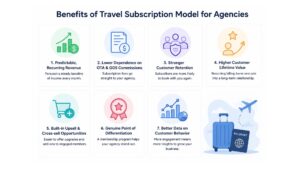
Benefits of Travel Subscription Model for Agencies
Let’s get specific about why this matters for an agency’s bottom line, not just the giants of the industry.
- Predictable, recurring revenue. Instead of guessing how many bookings will come in next month, agencies with a subscriber base can forecast a baseline of income regardless of seasonal travel dips.
- Lower dependence on OTA and GDS commissions. Subscription fees go straight to the agency — no intermediary taking a percentage.
- Stronger customer retention. A subscriber who’s already paying you monthly is far more likely to book their next trip through you instead of comparison-shopping elsewhere.
- Higher customer lifetime value. Recurring billing turns a single transaction into an ongoing relationship, which compounds in value over months and years.
- Built-in upsell and cross-sell opportunities. Members already engaged with your brand are easier to upgrade to premium tiers or sell add-ons like travel insurance or visa assistance.
- A genuine point of differentiation. Most small and regional agencies are still purely transactional — a well-run membership program is an easy way to stand out.
- Better data on customer behavior. Recurring engagement gives agencies far more touchpoints (and far more data) than a once-a-year booking ever could.
These benefits of the travel subscription model for agencies become even more pronounced in B2B contexts, where corporate clients and partner agents value predictable pricing and ongoing access just as much as individual travelers do—something we’ve seen play out through tools like a dedicated B2B agent portal that keeps partner relationships active between bookings rather than dormant.
Types of Travel Subscription Models Agencies Can Launch
There’s no single “right” way to structure a travel subscription. Here are the formats agencies are using most successfully right now.
- Discount or Cashback Membership Clubs
The lowest-friction option. Members pay a flat annual or monthly fee in exchange for a percentage off every booking, cashback on completed trips, or both—similar to AAA or Tripadvisor Plus.
- Trip-of-the-Month or Flight Subscriptions
Customers pay a fixed monthly fee and receive an actual flight, short break, or trip credit each cycle. Wizz Air’s Multipass is the clearest large-scale example, but smaller agencies have run similar models around regional weekend getaways.
- Premium Concierge and VIP Access Subscriptions
Higher price point, lower volume. Subscribers get priority customer support, dedicated travel consultants, early access to deals, and white-glove service — appealing to frequent business travelers and high-value leisure clients.
- B2B Subscription Models for Partner Agents
Rather than selling to end travelers, some agencies offer their sub-agents or corporate clients a paid tier of access—better commission splits, priority ticketing support, or advanced reporting tools—in exchange for a recurring fee.
- Digital Nomad and Long-Stay Memberships
A newer category aimed at remote workers, offering bundled access to accommodation across multiple destinations for one recurring fee—a model popularized by companies like Selina and Outsite and increasingly relevant as remote work reshapes travel patterns.
How to Launch a Travel Subscription Program
- Choose your model type. Decide between a discount club, a trip subscription, a premium concierge tier, or a B2B model based on your existing customer base.
- Set pricing and tiers. Most successful programs offer at least two tiers — an entry-level option and a premium one — to capture different customer segments.
- Build or integrate recurring billing. This is non-negotiable infrastructure; manual monthly invoicing simply won’t scale.
- Connect the subscription to your booking and inventory systems. Discounts and perks need to apply automatically at checkout, not through manual coupon codes your staff has to track.
- Market to your existing customers first. Your current client base is the easiest group to convert into subscribers—they already trust you.
- Track churn and lifetime value from day one. A subscription business lives or dies on retention, so these metrics matter more than almost anything else.
- Iterate based on real usage data. Expect to adjust pricing and perks within the first six months as you learn what actually keeps members renewing.

Technology You Need to Run a Travel Subscription Model
None of this works without the right technical foundation. At a minimum, a travel agency needs:
- Recurring billing and finance tracking to automate charges, manage refunds, and reconcile subscription revenue against commission-based income — the kind of capability built into IV Trip’s finance module, which already handles multi-currency transaction tracking for agencies.
- A CRM built for ongoing relationships, not just one-time leads. Subscribers need to be nurtured differently from first-time bookers, which is exactly the gap a dedicated CRM module is designed to close.
- Dynamic pricing capability, since membership discounts need to apply on top of (or instead of) real-time fare and rate fluctuations — something we’ve written about in more depth in our piece on dynamic pricing in travel agency software.
- Automated member communications, like renewal reminders, perk announcements, and re-engagement emails are what actually keep churn low — a use case well-suited to email automation in travel software.
- A broader SaaS mindset for the business itself. It’s worth noting that subscription thinking isn’t new to software — our own engineering team has written about how SaaS development is fundamentally built around subscription billing, and many of those same architectural lessons apply directly to building a travel subscription product.
If your agency is weighing whether to build this kind of system from scratch or extend an existing platform, our development team at Implevista works directly with travel and e-commerce businesses on exactly this kind of recurring-revenue infrastructure.
Challenges and Risks of Travel Subscription Models
It wouldn’t be honest to present this as risk-free. A few real challenges to plan for:
- Churn is the silent killer. Subscription businesses succeed or fail based on how long members stay, not just how many sign up. Without active retention efforts, monthly cancellations can quietly erode the model’s economics.
- Recurring billing adds operational complexity. Multi-currency support, failed payment retries, tax compliance, and refund handling all become ongoing responsibilities rather than one-off concerns.
- Inventory allocation for trip subscriptions is genuinely hard. If you’re promising an actual flight or stay each month, you need real capacity planning behind that promise.
- Member education takes effort. Many travelers still don’t fully understand how a travel subscription differs from a loyalty program, so agencies need to clearly communicate the value proposition upfront — which is where well-crafted content marketing plays a real role in explaining the offer rather than just listing it.
- Cannibalization risk. If your discounts are too generous, subscribers may end up costing you more in margin than they generate in fees — pricing this correctly requires real modeling, not guesswork.
Real-World Examples of Travel Subscription Success
- eDreams ODIGEO Prime – Grew from a 2017 soft launch to well over a million paying subscribers across multiple countries, offering discounted fares and priority support.
- TripAdvisor Plus – A paid annual membership offering discounted hotel stays and cashback on bookings.
- Wizz Air Multipass – Europe’s first airline flight subscription, letting members pay a fixed monthly fee for a set number of flights.
- AAA – One of the longest-running travel membership brands, bundling trip planning, discounts, and roadside assistance into one recurring fee.
- Selina and Outsite – Membership-style accommodation subscriptions built specifically around the growing digital nomad and remote-work travel segment.
What’s notable across all of these examples is that none of them required reinventing the travel business itself—they layered a subscription revenue stream on top of services these companies were already offering.
How IV Trip Helps Travel Agencies Launch Subscription Models
IV Trip gives travel agencies the tools needed to build and manage their own subscription or membership-based travel programs. With features like recurring transaction tracking, customer relationship management, and dynamic pricing for member-exclusive fares, agencies can create flexible travel experiences that encourage long-term customer loyalty.
Whether you’re planning a travel membership club, recurring vacation package, or VIP traveler program, IV Trip provides the operational foundation to support it. Agencies can manage member interactions, automate workflows, and offer personalized pricing through a single platform designed for modern travel businesses.
Explore our pricing plans or contact our team to discuss how a subscription-based model could work for your agency.
Frequently Asked Questions
- What is a travel subscription model?
A travel subscription model is a recurring fee—usually monthly or annual—that a travel business charges in exchange for ongoing access to discounts, perks, cashback, or, in some cases, an actual trip or flight credit each billing cycle.
- How is a travel subscription different from a loyalty program?
Loyalty programs are free and reward customers after they’ve already spent money. Travel subscriptions are paid upfront and generate direct recurring revenue for the agency, regardless of whether the member books that month.
- What are the main benefits of a travel subscription model for agencies?
The biggest benefits of the travel subscription model for agencies include predictable recurring revenue, lower dependence on OTA commissions, stronger customer retention, higher lifetime value, and better long-term customer data.
- How does the subscription model work for a small travel agency?
A customer signs up and enters payment details once; the agency’s system bills them automatically on a set cycle, the member receives their promised perks or trip, and the subscription renews automatically unless cancelled.
- What types of travel subscriptions exist?
The two broad categories are trip subscriptions (the customer receives an actual trip or flight) and membership clubs (the customer receives discounts, cashback, or access without a guaranteed trip).
- Are travel subscriptions profitable for small agencies?
They can be, provided pricing is modeled carefully, and churn is actively managed. Discount-based membership clubs tend to be the lowest-risk entry point since they don’t require holding inventory aside for subscribers.
- What technology do agencies need to launch a travel subscription program?
At minimum: recurring billing and finance tracking, a CRM built for ongoing relationships, dynamic pricing integration, and automated member communications to manage renewals and reduce churn.
- What is the biggest risk of a travel subscription model?
Churn. If members cancel faster than new ones join, or if discounts are priced too generously, the recurring revenue model can erode an agency’s margins rather than strengthen them.
- Can B2B travel agencies use subscription models too?
Yes. Some agencies offer paid subscription tiers to their partner sub-agents or corporate clients, providing benefits like better commission splits or priority support in exchange for a recurring fee.
- What are some real examples of travel subscription programs?
eDreams ODIGEO Prime, Tripadvisor Plus, Wizz Air’s Multipass, AAA, and accommodation-focused memberships like Selina and Outsite are all established examples of travel subscription models in action.
Final Thoughts
The travel industry has spent the better part of a century built around the single transaction—book a trip, collect a commission, and start over. Travel subscription models break that cycle. They turn a one-time customer into an ongoing relationship, and they give agencies something the booking-by-booking model never could: predictable, recurring revenue that doesn’t evaporate the moment travel demand dips.
It’s not a strategy without risk, and it’s not a strategy that works without the right technology behind it. But for agencies willing to put in the planning — and the infrastructure — travel subscriptions represent one of the clearest new growth paths available in the industry right now.
If you’re considering building a subscription or membership program for your travel business, get in touch with our team at IV Trip to talk through what that could look like on your platform. You can also explore our full feature set to see the infrastructure already in place to support it, or subscribe to the IV Trip blog for more deep dives into travel technology and revenue strategy. For agencies further along in scaling, our parent company Implevista’s case studies show how recurring, technology-driven business models have played out across other industries, too.