

What Are AI Travel Agents: 7 Secrets to Travel Automation
Introduction: The End of Travel Planning Chaos
Trip planning used to be fragmented and exhausting. Travelers and agencies spent days cross-referencing flights, hunting hotel deals, and using rigid legacy networks. Creating complex, multi-stop itineraries required manual data entry and constant platform switching. These processes left room for costly errors and inefficiency.
AI travel agents are ending this chaos. They shift from rigid manual input to fluid, natural language intent. These systems redefine travel automation. Businesses use them to predict pricing, remove clerical mistakes, and provide proactive 24/7 care. What was once a multi-day task is now a flawless, automated process.
What Are AI Travel Agents?
To fully grasp the magnitude of this structural shift, it is essential to establish a precise operational definition. AI travel agents represent an advanced class of autonomous enterprise software. Driven by an underlying architecture of Large Language Models (LLMs), deep machine learning algorithms, and natural language processing (NLP), these systems are engineered to manage, optimize, and execute complex trip-planning workflows for both individual consumers and B2B travel operations.
Crucially, these modern agents share no architectural lineage with the rigid, rule-based chatbots of the previous decade. While legacy software relied on static, preprogrammed script loops that often caused user friction, contemporary AI travel agents operate dynamically. They are predictive, context-aware, and deeply synchronized with real-time global distribution systems (GDS) and inventory databases, enabling them to interpret complex human intent and autonomously orchestrate end-to-end travel solutions.
The Shift from Reactive to Proactive Engagement
The core differentiator of a true autonomous agent is its shift from a reactive state to a proactive state:
- Traditional Chatbots: You ask, “What time is my flight?” The bot asks for your booking reference, searches a closed database, and spits back a time. It is purely reactive and linear.
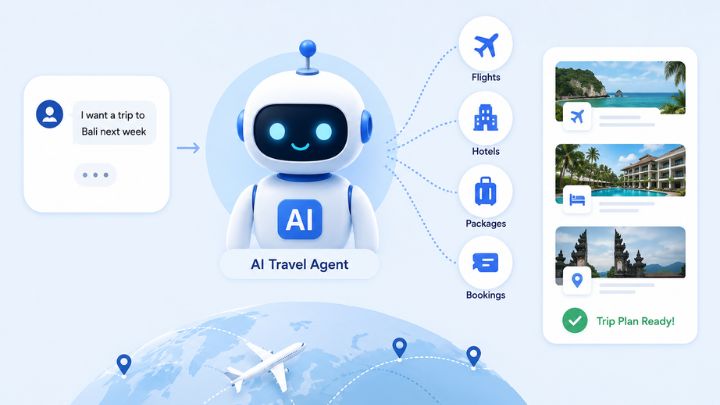
- AI Travel Agents: You say, “I want to go to a beach destination in December with my spouse and two kids under five, and my absolute budget is BDT 350,000.” Within seconds, the AI analyzes millions of data points, cross-references family-friendly resorts, checks real-time flight pricing, evaluates weather trends, and generates three complete, bookable itineraries. It is highly proactive and contextual.
These agents can seamlessly understand natural human language, interpret complex emotional constraints, and execute multi-platform tasks. They are the ultimate embodiment of modern travel automation, taking the exhausting heavy lifting out of trip curation.
The 7 Secrets to Travel Automation Unlocked
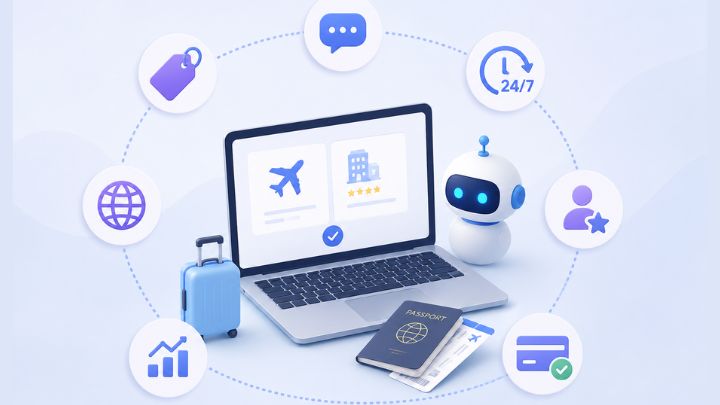
To truly dominate the modern tourism landscape, simply installing a basic software portal isn’t enough. You need to know how to leverage the hidden engineering mechanics of intelligent systems. Here are the 7 secrets to travel automation that allow top-tier agencies to scale effortlessly using AI travel agents:
Secret 1: Smart Booking Through Natural Conversations
Traditional systems require an agent to manually input precise airport codes, exact calendar dates, and strict class types into a terminal. The secret to AI-driven travel automation is its ability to extract “intent” from natural conversation. A traveler can casually type, “I want to go somewhere tropical after Christmas for a week,” and the AI instantly maps out the underlying logic, automatically queries the live systems of local carriers like Biman Bangladesh or US-Bangla, and presents bookable options without a single manual drop-down menu being clicked.
Secret 2 Real-Time Pricing and Availability Updates
The downfall of many standard travel sites is the dreaded “price jump” at checkout, caused by cached data that updates too slowly on older servers. Advanced AI travel agents bypass static databases entirely. They use multi-threaded, parallel API calls to retrieve real-time seat and room availability directly from global GDS networks. This ensures the price quoted in a chat window is 100% accurate at the exact split second of purchase.
Secret 3: Smarter Price Predictions
AI doesn’t just look at what is available right now; it tracks historical patterns across years of data. A major secret to maximizing agency profit margins is letting the machine predict price fluctuations. If a client wants to book a flight to London for the summer, the AI uses predictive analytics to advise the agent:
“Hold off on ticketing for 4 days. Historically, this specific route drops by 12% on Tuesday afternoons.”
Secret 4: 24/7 Automated Customer Support
The math behind scaling an agency without doubling your human payroll relies entirely on autonomous customer service. While your local team in Dhaka sleeps, the AI acts as a “ghost agent.” If a client experiences a mid-journey disruption—such as a midnight flight delay in London—the AI intercepts the live aviation feed, automatically scans alternative partner airlines for the next available connection, and seamlessly sends the new boarding pass to the customer’s smartphone via WhatsApp.
Secret 5: Personalized Travel Offers and Upgrades
Pushy sales pitches alienate modern consumers. The automation secret to boosting average order value (AOV) is context-aware placement. Instead of blasting generic emails, the AI tracks individual user data. If a traveler hooks up an economy flight but historically purchases premium lounge access, the AI sends a hyper-targeted, one-click upgrade option directly to their mobile screen right when they are most likely to buy: exactly 48 hours before departure.
Secret 6: Multi-Language Customer Communication
Operating in a global market usually requires hiring expensive bilingual staff for every targeted region. The secret weapon of AI in travel industry applications is native Cross-Language NLP translation. A client can text their specific demands in Bengali; the AI automatically translates and queries global hotel databases in English, receives the raw structural data, and outputs a flawlessly formatted, localized itinerary back to the client in Bengali instantly.
Secret 7: Automated Payment and Booking Management
The back-office nightmare of every agency is matching booking references, Mobile Financial Services (MFS) transaction IDs (bKash/Nagad), and supplier invoices. Advanced automation engines feature “self-healing” reconciliation logic. The system continuously runs automated audits across your ledger, instantly flagging inconsistencies in markups or local taxes so your finance team spends zero hours fixing broken records manually.
How Do AI Travel Agents Actually Work?
The magic of AI travel agents isn’t magic at all; it is an organized symphony of data processing, real-time API integrations, and cloud computing. Let’s look at the underlying technical architecture.
Natural Language Processing (NLP)
This is the foundational framework that allows the machine to comprehend human dialogue. When a user types a complex query—even one riddled with typos, colloquialisms, or mixed languages—NLP breaks down the sentence into distinct “tokens” to isolate the core intent. It understands that “a cheap flight to NYC next Friday” means searching for economy class, finding the specific date for the upcoming Friday, and targeting JFK, LGA, or EWR airports simultaneously.
Machine Learning & Predictive Analytics
Every interaction makes the AI inherently smarter. Through continuous machine learning, these agents analyze historical booking data, seasonal trends, and individual user behaviors. If the AI notices that a particular user always books 4-star boutique hotels with gym access, it will automatically prioritize those specific results in future searches without needing to be prompted, creating a hyper-tailored user experience.
Benefits of AI Travel Agents for Travel Agencies
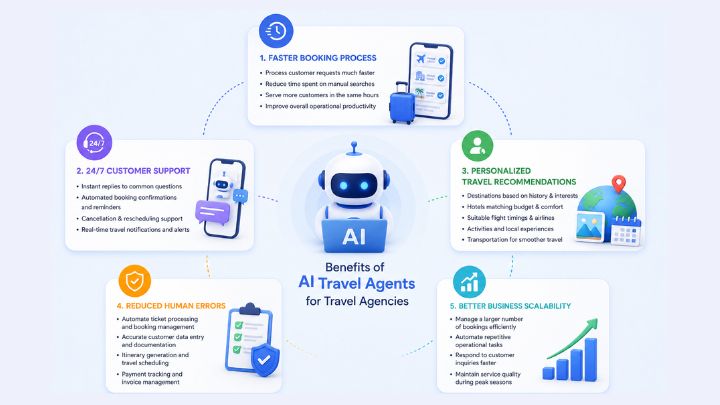
The biggest advantage of AI travel agents is efficiency.
Travel agencies can automate repetitive tasks while improving customer satisfaction at the same time.
Here are the major benefits.
Faster Booking Process
AI systems can compare flights, hotels, and tour packages within seconds.
Instead of manually checking multiple platforms, agents receive instant recommendations and booking options.
This helps agencies:
- process customer requests much faster
- Reduce time spent on manual searches.
- serve more customers within the same working hours
- improve overall operational productivity
24/7 Customer Support
Travel customers often need support outside office hours.
With AI travel agents, agencies can provide:
- instant replies to common customer questions
- automated booking confirmations and reminders
- cancellation assistance and rescheduling support
- real-time travel notifications and alerts
Even during midnight flight disruptions, AI systems can continue supporting travelers.
This is one of the biggest advantages of travel automation.
Personalized Travel Recommendations
Modern travelers expect customized experiences.
AI systems analyze customer preferences to recommend:
- destinations based on travel history and interests
- hotels that match budget and comfort expectations
- suitable flight timings and airline choices
- activities and local experiences that travelers may enjoy
- transportation options for smoother travel planning
This helps agencies deliver better service without increasing workload.
Reduced Human Errors
Manual booking mistakes can create serious problems.
AI systems reduce errors by automating:
- ticket processing and booking management
- customer data entry and documentation
- itinerary generation and travel scheduling
- payment tracking and invoice management
This improves operational accuracy for agencies.
Better Business Scalability
Agencies can handle more customers without hiring large support teams.
A small team using AI travel agents can:
- manage a larger number of bookings efficiently
- automate repetitive operational tasks
- Respond to customer inquiries faster.
- maintain service quality during peak travel seasons
This makes growth easier and more cost-effective.
Overcoming the Debate: Will AI Replace Human Travel Agents?
Whenever we discuss the rise of AI travel agents, an inevitable question arises: Are human agents going to lose their jobs?
The definitive answer is no. The reality is that human agents who refuse to use AI will be replaced by human agents who do use AI.
The role of the travel professional is rapidly evolving from a “booking clerk” to a strategic “travel advisor.” While the AI handles the tedious, data-heavy tasks—comparing 500 different flight routes, calculating local tax variations, and formatting itinerary PDFs—the human agent focuses on empathy, complex negotiation, and relationship building.
Think of AI travel agents as the ultimate digital co-pilot. They empower human agents to handle 10x their current volume of clients without sacrificing the quality of service. This synergy is exactly what modern digital transformation strategy is all about—amplifying human potential with machine efficiency.
How Consumers Experience AI Travel Agents
While agencies reap the massive backend operational benefits, the end consumer experiences a completely redefined, frictionless booking journey. Here is how AI in travel industry applications is changing the way people explore the world:
- Dynamic Price Optimization: Instead of manually refreshing a browser tab for weeks to find a cheap flight, a traveler can tell their AI agent their ideal target budget. The AI monitors global flight paths 24/7, using predictive algorithms to determine if prices will drop or rise, and can execute the booking automatically when the optimal price hits.
- Context-Aware Itinerary Generation: If a traveler asks an AI for a “3-day itinerary in Rome,” the AI doesn’t just provide a generic list of monuments. It asks clarifying questions regarding their interests, who they are traveling with, and their physical mobility levels. It then creates a custom plan complete with mapped-out walking routes and restaurant reservations.
- Real-Time In-Destination Support: The role of AI travel agents doesn’t end once the flight takes off. They act as on-the-ground guides. If unexpected weather disrupts a trip, the AI can proactively send an updated notification with alternative indoor activities or rebooked excursions instantly.
Real-World Use Cases: Travel Automation in Action
To truly grasp the power of this technology, let’s look at practical, real-world applications of travel automation that forward-thinking agencies are deploying today.
Case Study 1: The Automated Disruption Manager
Flight delays and cancellations are an unavoidable part of travel. Traditionally, a canceled flight means standing in massive airport lines or spending hours on hold with airline customer service. Today, advanced AI travel agents monitor global aviation feeds in real time. The moment a flight is flagged as canceled, the AI automatically searches for the next available flight on any partner airline, rebooks the ticket, and sends the new boarding pass to the traveler’s phone before they even reach the service desk. Customer service experts at HubSpot note that proactive problem resolution is the number one driver of modern brand loyalty.
Case Study 2: Intelligent Upselling Engines
Agencies thrive on ancillary margins, and upselling is critical to profitability. An AI system analyzes a traveler’s booking profile. If they booked a flight to a ski resort but haven’t added baggage, the AI sends a targeted message: “I noticed you’re heading to Aspen. Do you need to add oversized baggage for your skis? I can add it now for a 20% discount compared to airport prices.” This frictionless upselling drives massive revenue for agencies without feeling intrusive to the consumer.
Integrating AI: The IV Trip Advantage
For travel agencies in Bangladesh and across South Asia, the prospect of building a custom AI system from scratch is an incredibly daunting and financially prohibitive task. This is where partnering with a specialized travel technology provider becomes essential.
At Implevista, we have poured years of engineering expertise into our flagship product, IV Trip. Our goal is to democratize travel automation, giving local agencies direct access to enterprise-grade technology.
By utilizing IV Trip, your agency can leverage built-in smart tools to automate ticketing, manage complex B2B sub-agent networks, handle localized payment gateways, and curate stunning, dynamic itineraries in a fraction of the time. We bridge the gap between traditional travel knowledge and cutting-edge software engineering. To see how these tools are continuously evolving, you can explore the latest travel tech trends on our blog.
Conclusion: Embrace the AI Revolution
We have answered the core question, “What are AI travel agents?” They are the tireless, hyper-intelligent, and proactive engines driving the future of global exploration. From eliminating the stress of manual planning to providing agencies with unparalleled travel automation, AI is reshaping the landscape of tourism from top to bottom.
For travel business owners, the mandate is clear: The time to modernize your digital infrastructure is right now. By integrating AI-driven tools into your core workflows, you can reduce operational overhead, eliminate human error, and provide your clients with seamless experiences that build lifelong brand loyalty.
Ready to Transform Your Travel Agency?
- Explore IV Trip: Discover the full feature suite of Bangladesh’s premier travel agency software platform.
- Subscribe to our Blog: Stay ahead of the competition with weekly deep dives into AI, travel tech innovations, and digital transformation strategy.
- Read a Related Post: Learn more about how modern API integrations are changing flight bookings in our recent tech deep-dive on the Implevista Digital Blog.
FAQs About AI Travel Agents
- What exactly are AI travel agents?
AI travel agents are intelligent software systems that utilize natural language processing, machine learning, and direct API integrations to completely automate travel planning, booking, and itinerary management for consumers and agencies.
- Will AI travel agents replace human travel agents entirely?
No. They function as powerful co-pilots, automating tedious backend processes (like flight searching and data reconciliation) so human agents can focus on high-value client advisory roles.
- How do AI travel agents save money for travel businesses?
They dramatically lower operational overhead by automating manual tasks, minimizing costly data-entry errors in ticketing, and providing automated 24/7 client support without expanding night-shift payroll.
- Are AI travel agents capable of booking complex, multi-city trips?
Yes. Modern AI agents can process millions of routes, connections, hotel databases, and transit paths simultaneously to construct optimized, multi-destination itineraries in seconds.
- How does travel automation improve the end-customer experience?
It eliminates waiting times by offering instant responses, hyper-personalized recommendations based on past behaviors, and proactive solutions like automated rebooking during flight delays.
- Can AI travel agents handle dynamic pricing alerts?
Absolutely. They can track global fare and property trends 24/7, notifying agents or customers the exact moment a specific route hits its optimal target price.
- Is customer data safe within AI in travel industry platforms?
Reputable enterprise platforms, such as those built by Implevista, implement top-tier encryption standards and comply with global data protection frameworks to secure client profiles and financial records.
- How do AI agents learn what a specific traveler prefers?
Through machine learning loops, the AI analyzes a traveler’s previous booking habits, interactions, and explicit parameters (e.g., preference for specific airlines) to tailor future options.
- Can small or independent travel agencies afford AI technology?
Yes. By adopting cloud-based SaaS platforms like IV Trip, small and medium-sized agencies can deploy advanced travel automation capabilities without large custom software development budgets.
- Do AI travel agents work across different languages?
Yes. Advanced AI systems feature native cross-language NLP engines, allowing users to converse or input data in languages like Bengali and instantly map it to global travel databases.