

Digital Transformation in Travel: SaaS vs Agencies

Walk into most travel agencies twenty years ago, and you’d find the same scene everywhere: stacks of paper itineraries, a landline ringing off the hook, and an agent manually cross-checking airfares against a printed fare sheet. Fast forward to today, and that picture looks almost unrecognizable. A customer in Dhaka can now compare flights, book a hotel in Kuala Lumpur, pay in BDT, and receive an instant e-ticket, all before finishing their morning coffee.
That shift didn’t happen by accident. It’s the result of digital transformation in travel, a wave of cloud software, automation, and AI that’s quietly rewriting how travel businesses operate. And at the center of this shift is a genuine turf war: SaaS platforms versus traditional agency operations.
This isn’t a theoretical debate. Travel agencies that still run on spreadsheets and phone calls are losing ground to competitors who’ve adopted Software-as-a-Service (SaaS) systems that automate bookings, manage finances, and personalize customer experiences at scale. In this article, we’ll break down exactly what digital transformation in travel looks like in practice, compare SaaS platforms against traditional agency models, and show you a practical path for making the switch, without the guesswork.
What Is Digital Transformation in Travel
Digital transformation in travel isn’t just “using a computer instead of paper.” It’s a complete rethinking of how a travel business operates, from the moment a customer starts searching for a flight to the moment they land back home.
At its core, digital transformation in travel involves:
- Moving core operations to the cloud: bookings, invoicing, and CRM data are accessible from anywhere, on any device.
- Automating repetitive tasks: fare comparisons, confirmation emails, commission calculations, and reporting.
- Connecting to real-time data sources: through APIs that pull live pricing and availability from global airlines, hotels, and suppliers.
- Personalizing the customer journey: using data and AI to recommend the right package, price, or destination to the right traveler.
Industry researchers estimate the global travel technology market will grow from roughly USD 12 billion in 2026 to more than USD 23 billion within the next decade, with close to half of that growth driven directly by SaaS and AI adoption across airlines, hotels, and travel agencies. In other words, this isn’t a passing trend; it’s where the entire industry is headed.
The Traditional Travel Agency Model: What Made It Work, and Where It Breaks
To be fair to the traditional model, it earned its place. Human agents built relationships, handled complex itineraries no algorithm could untangle, and offered a level of personal trust that mattered, especially for high-stakes trips like Hajj, Umrah, or student visa journeys.
But the traditional agency model was built for a slower, smaller-scale world. As customer volume grows and expectations shift toward instant, 24/7 service, the cracks start to show.
The Manual Bottlenecks Still Holding Agencies Back
Agencies still relying on manual, disconnected processes typically run into the same recurring problems:
- Fragmented systems. Bookings live in one tool, invoicing in another, and customer records in a third, with no single source of truth.
- Human error at scale. Manually re-entering passenger details or fare data across multiple platforms invites costly mistakes.
- Limited availability. A phone-and-storefront model can’t serve customers outside business hours, while online competitors operate around the clock.
- Slow reporting. Owners often don’t know their real profit margins or agent performance until weeks after the fact.
- Difficulty scaling. Adding more staff to handle more bookings doesn’t scale as well as automated systems do, and costs rise faster than revenue.
None of this means agencies are doing something wrong; it simply means the tools they’re using weren’t designed for the volume and speed today’s travelers expect.
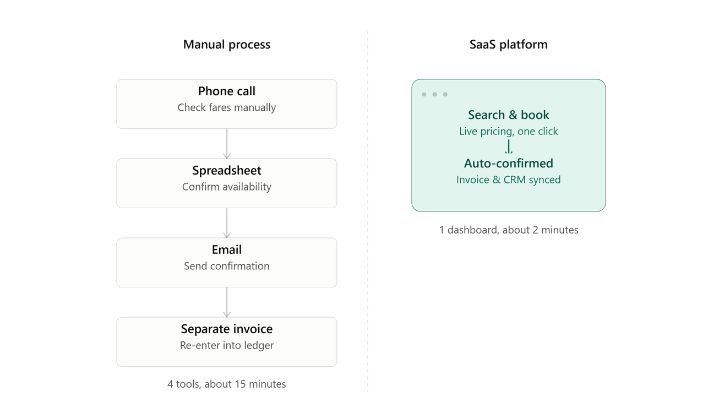
SaaS vs Traditional Travel Agencies: A Side-by-Side Look
This is where the comparison between SaaS and traditional travel agencies becomes really useful for decision-makers. Both models can serve customers, but they do it very differently.
| Factor | Traditional Agency Operations | SaaS Travel Platforms |
| Booking speed | Manual checks, phone/email confirmations | Real-time booking via GDS/API integration |
| Availability | Limited to office hours | 24/7 self-service and automated support |
| Data visibility | Scattered across spreadsheets, registers | Centralized dashboards and live reporting |
| Scalability | Requires proportionally more staff | Scales with minimal added headcount |
| Customer experience | Personal, but slower | Personalized and fast, via AI and automation |
| Upfront cost | Lower tech investment, higher long-term labor cost | Subscription-based, predictable monthly cost |
| Error rate | Higher due to manual re-entry | Lower, thanks to automated data sync |
| Multi-channel reach | Primarily walk-in/phone | Web, mobile app, B2B portal, OTA integrations |
The takeaway isn’t that traditional agencies are obsolete, since many successful agencies still lead with a human touch. The real story is that the agencies thriving today are the ones layering SaaS travel software underneath that human touch, rather than choosing one over the other. You can read more about how this shift has unfolded specifically across South Asia in our earlier piece on digital transformation in travel agencies of South Asia.
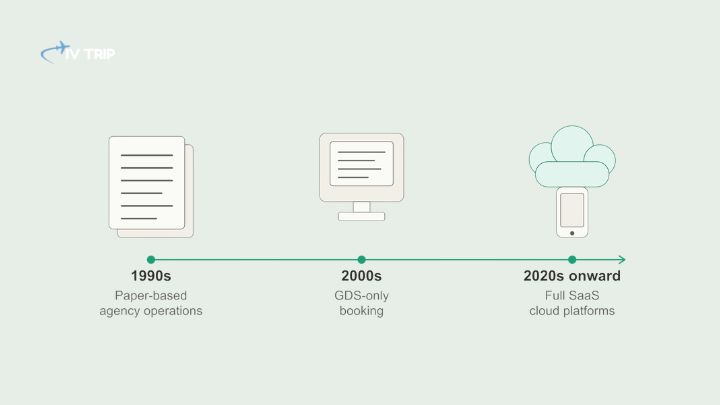
Travel Agency Automation: Where the Time and Money Actually Get Saved
If digital transformation in travel is the big-picture shift, travel agency automation is where it becomes tangible: the specific, everyday tasks that no longer need a human doing them manually.
Task Automation Takes Off an Agent’s Plate
- Fare and price comparisons are automatically pulled from multiple suppliers instead of being manually checked one by one.
- Booking confirmations and e-tickets are generated and sent instantly after payment.
- Commission calculations are computed automatically per booking, per agent, per supplier.
- Invoicing and reconciliation are synced directly with the booking engine, reducing accounting backlogs.
- Follow-up emails and reminders are triggered automatically based on trip dates or customer behavior.
- Reporting and KPIs are refreshed in real time instead of being compiled manually at month-end.
Agencies that adopt structured travel agency automation don’t just save time; they free up agents to focus on the parts of the job that genuinely need a human: resolving complex requests, upselling packages, and building customer relationships. That combination, automation handling the repetitive work while humans handle the judgment calls, is really the heart of digital transformation in travel done well.
B2B Travel Software Solutions: The Backbone of Modern Agency Networks
Not every travel business sells directly to travelers. A huge part of the industry runs on B2B travel software solutions, platforms that let one agency sell inventory through a network of sub-agents, corporate clients, or partner agencies.
A solid B2B travel portal typically includes the following:
- Agent-level login and commission tracking, so every sub-agent sees their own rates and margins.
- Centralized inventory for flights, hotels, and packages that sub-agents can book without needing their own supplier contracts.
- Credit and ledger management so that agencies can extend controlled credit to trusted partners.
- White-label branding lets partner agencies present the platform under their own name.
This is particularly relevant in markets like Bangladesh, where a large share of ticketing and package sales flows through smaller sub-agents connected to a handful of larger consolidators. Without B2B travel software solutions, managing that network manually, tracking who owes what and who booked what at what rate, becomes a full-time accounting headache. With the right platform, it becomes a dashboard. You can see how this plays out in practice in our breakdown of B2B travel agency software in Bangladesh.
AI in Travel Booking: The New Front Line of Customer Experience
Ask ten travelers what frustrates them most about booking a trip, and “waiting for a response” will come up again and again. That’s exactly the gap AI in travel booking is closing.
Modern travel platforms now use AI to:
- Answer routine questions instantly through chatbots and conversational assistants, covering visa requirements, baggage rules, and cancellation policies.
- Recommend personalized packages based on a traveler’s past searches and booking history.
- Predict pricing trends, helping both agencies and travelers time their bookings better.
- Flag anomalies, such as unusual booking patterns that might indicate fraud.
This doesn’t replace human agents; it filters out the repetitive 80% of inquiries so agents can spend their time on the 20% that actually need a person. It’s a theme we’ve explored in depth in our articles on AI and chatbots in the travel industry, as well as on conversational AI for travel agencies. For any agency asking “is this really necessary,” the honest answer is that it’s quickly becoming the baseline customers expect, not a bonus feature.
API-Driven Travel Platforms: The Infrastructure Behind Seamless Bookings
Behind every instant flight confirmation is something travelers never see: an API-driven travel platform quietly talking to airline systems, hotel inventories, and payment gateways in real time.
An API (Application Programming Interface) is essentially a bridge that lets two systems exchange data instantly. In travel, this means:
- A booking engine can pull live seat availability from an airline the second a customer searches.
- A payment gateway can confirm and settle a payment without a human touching the transaction.
- A CRM can automatically log every interaction a customer has, from search to post-trip follow-up.
This is what makes Global Distribution Systems (GDS) like Sabre, Amadeus, and Travelport, along with regional providers like Mystifly, so central to modern travel software. Agencies plugged into these systems through API-driven travel platforms can offer the same real-time pricing and availability as major international OTAs, without needing to build that infrastructure themselves. Our detailed guide on third-party API integration walks through exactly how this connectivity works and why it matters for agencies of any size.
Online Travel Agencies (OTAs) vs the Traditional Storefront
Online travel agencies (OTAs) deserve their own mention here because they represent digital transformation in travel taken to its logical extreme: a fully self-service, digital-first booking experience with no physical storefront required.
Consider the traveler behavior driving this shift: research from Google shows that roughly 70% of travelers with smartphones now do travel research directly from their phone before booking. That’s a customer base that expects to search, compare, and confirm a booking without ever picking up a phone.
The good news for traditional agencies is that becoming an OTA doesn’t require abandoning the agency model; it simply means adding a digital storefront on top of it. A travel agency can operate its physical office and B2B network and run a fully functioning OTA from the same backend, serving both walk-in customers and online bookers from one system. We cover exactly how agencies make this leap in our guide on how to start an online travel agency (OTA).
Why Bangladesh Is a Live Case Study of Digital Transformation in Travel
Bangladesh offers a particularly clear window into this shift. Outbound travel, Hajj and Umrah pilgrimages, student visa processing, and medical tourism collectively drive enormous booking volume, and much of it still runs through small and mid-sized agencies. At the same time, over 65% of travel agencies in the country have already adopted some form of digital tooling, yet a significant share still struggles with generic or foreign software that doesn’t support local payment gateways, BDT pricing, or Bengali-language interfaces. That’s the gap that local, purpose-built travel agency software in Bangladesh is specifically designed to close.
The result is a market where agencies that adopt cloud-based, locally adapted SaaS platforms are pulling ahead quickly, not because they abandoned their relationship-driven service model, but because they layered automation, real-time booking, and mobile access on top of it. It’s a pattern playing out across the wider travel software market, and Bangladesh is very much at the center of it. If you’re running a traditional agency and reading this thinking “that’s us,” the shift to SaaS doesn’t have to happen overnight, and it doesn’t require throwing out everything that works.
A Practical Migration Checklist
- Audit your current workflow. Identify exactly where time gets lost, whether in booking, invoicing, follow-ups, or reporting.
- Choose cloud-based infrastructure first. Moving your booking and customer data to the cloud is the foundation on which everything else is built. Our guide to cloud-based travel management solutions is a useful starting point.
- Connect to GDS/API providers. This is what unlocks real-time pricing and availability, rather than manual fare checks.
- Automate one workflow at a time. Start with invoicing or confirmations before tackling more complex processes like commission tracking.
- Train your team gradually. Automation works best when staff understand why a task changed, not just how to click through the new system.
- Layer in AI and personalization last. Once the operational basics are automated, AI-driven recommendations and chat support become far more effective.
This staged approach avoids the most common failure point in digital transformation in travel projects: trying to change everything at once and overwhelming both staff and customers.
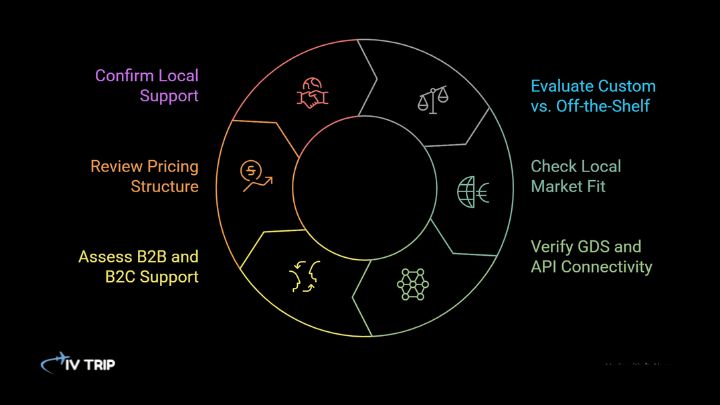
Choosing the Right Travel SaaS Partner
Not all travel SaaS platforms are built the same way, and the decision often comes down to one core question: custom-built or off-the-shelf? We’ve broken this exact decision down in detail in custom travel agency software vs off-the-shelf solutions, but the short version is this: off-the-shelf platforms get you moving faster and cost less upfront, while custom solutions offer deeper flexibility for agencies with unique workflows.
When evaluating a partner, look for:
- Local market fit, meaning currency, language, and payment gateway support relevant to your customers.
- GDS and API connectivity give you access to major suppliers like Sabre, Amadeus, Travelport, and regional carriers.
- B2B and B2C support in one platform, so you’re not managing two separate systems.
- Transparent, scalable pricing that grows with your booking volume instead of penalizing growth.
- Local support, someone who understands your market’s regulatory and operational realities.
If you want to see how these criteria stack up against other platforms in the market, our comparison guide on IV Trip vs other travel agency software is a good next read.
IV Trip: A SaaS Platform Built for This Exact Shift
IV Trip is a good example of what digital transformation in travel looks like when it’s put into practice rather than just talked about. It’s a cloud-based, subscription-model SaaS platform, which means agencies don’t need to buy servers, hire an in-house development team, or maintain their own infrastructure. Everything, from flight and hotel booking to accounting, CRM, and B2B agent management, runs through one system that’s accessible from a browser or mobile app, anywhere there’s an internet connection.
What makes IV Trip specifically relevant to this SaaS vs traditional agency conversation is that it doesn’t force agencies to choose one model over the other. It connects directly to major GDS and API providers like Sabre, Amadeus, Travelport, and Mystify, so agencies get real-time pricing and availability without building that connectivity themselves. At the same time, it supports the B2B agent networks, sub-agent commission tracking, and BDT-based accounting that Bangladeshi and South Asian agencies already rely on, so the human, relationship-driven side of the business stays intact.
New features roll out automatically as part of the subscription too, meaning agencies stay current with AI-driven tools like conversational booking assistants without a separate upgrade project every time. For agencies weighing whether to build custom software or adopt something ready-made, our comparison of IV Trip vs other travel agency software breaks down exactly where it fits.

Frequently Asked Questions: Digital Transformation in Travel
- What is digital transformation in travel?
Digital transformation in travel refers to the shift from manual, paper-based agency operations to cloud-based, automated systems that handle booking, payments, reporting, and customer communication in real time.
- Is SaaS travel software replacing traditional travel agencies?
Not entirely. SaaS is replacing the manual processes inside agencies, not the agencies themselves. Agencies that adopt SaaS platforms tend to outperform those that don’t, rather than disappear.
- What’s the real difference between SaaS and traditional travel agencies?
Traditional agencies rely on manual booking and phone-based service, while SaaS platforms automate bookings, centralize data, and enable 24/7 self-service, often within the same agency.
- What does travel agency automation actually save time on?
Mainly repetitive tasks: fare comparisons, booking confirmations, commission calculations, invoicing, and reporting, which frees staff to focus on customer relationships.
- What is B2B travel software used for?
B2B travel software lets one agency distribute inventory (flights, hotels, packages) through a network of sub-agents or partner agencies, with automated commission and credit tracking.
- How is AI used in travel booking today?
AI powers chatbots for instant customer support, personalized package recommendations, dynamic pricing insights, and fraud detection, reducing response times significantly.
- What is an API-driven travel platform?
It’s a system that connects directly to airline, hotel, and payment provider databases through APIs, allowing real-time pricing, availability, and booking confirmation without manual checks.
- What’s the difference between an OTA and a traditional travel agency?
An OTA (online travel agency) operates primarily through a digital, self-service platform, while a traditional agency relies on in-person or phone-based service, though many agencies now run both models together.
- How much does travel agency software typically cost?
Pricing varies by provider and feature set, usually structured as a monthly subscription based on booking volume or number of users. It’s best to request a quote based on your agency’s specific needs.
- How long does it take to migrate from manual operations to a SaaS platform?
This depends on agency size and complexity, but a phased migration, starting with cloud data storage, then automation, then AI features, typically shows measurable results within the first few months.
Conclusion: The Future Belongs to Agencies That Adapt
Digital transformation in travel isn’t a distant trend anymore; it’s the current baseline for how competitive travel businesses operate. The agencies pulling ahead aren’t necessarily the ones with the biggest budgets; they’re the ones willing to automate the repetitive work, connect to real-time data through API-driven travel platforms, and meet customers wherever they’re searching, whether that’s a B2B partner network or a mobile app at 11 p.m.
The traditional agency model isn’t dead. But operating it without the support of modern SaaS travel software is an increasingly difficult way to compete. The good news is that the shift doesn’t require reinventing your business overnight; it starts with automating one workflow, connecting one API, and building from there.
Ready to see what digital transformation in travel looks like for your agency? Book a free demo with IV Trip and see how our platform handles flight booking, hotel reservations, B2B agent management, and accounting in one system, built specifically for agencies in Bangladesh and South Asia. You can also explore our full feature set, check pricing, or subscribe to the IV Trip blog for more insights on travel technology, automation, and industry trends.