

Generative AI in Tourism: A Travel Breakthrough Moment

The travel industry is experiencing a significant shift. What used to require hours of research, phone calls, spreadsheets, and manual coordination can now become smooth, automated, and personalized. Thanks to advances in generative artificial intelligence, travel agencies and tour operators can now reimagine every step of the customer journey, from the moment a traveler thinks “Where should I go?” to the moment they confirm a booking.
For agencies in Bangladesh and beyond, especially those powered by IV Trip, generative AI in tourism offers a powerful opportunity. It can transform how travelers search for destinations, how agencies design itineraries, how bookings are processed, and how customers are served—the result: faster service, happier customers, and more efficient operations.
This article examines what generative AI in tourism is, why it matters for the tourism sector, how it’s being applied across the entire travel lifecycle, and how integrating modern travel agency platforms—including CRM solutions tailored for the industry—with AI capabilities can create meaningful value for agencies, agents, and travelers.
What is Generative AI in Tourism and Why It Matters
Generative AI refers to a class of artificial intelligence technologies capable of creating new content, whether text, images, itineraries, or recommendations, by learning patterns from large volumes of data. In the context of tourism, generative AI can analyze travelers’ preferences, past behavior, available offerings, and numerous variables to generate personalized suggestions and plans.
In simple terms, generative AI goes beyond rigid, rule-based automation. It can think creatively, adapt to a traveler’s unique tastes, and offer custom-tailored experiences. For travel agencies, this marks a shift from one-size-fits-all packages to highly personalized, dynamic travel planning that feels bespoke.
The impact on tourism can be transformative. By using generative AI in tourism, agencies can deliver better customer experience, reduce operational friction, and offer services at scale that would otherwise require much more human effort.
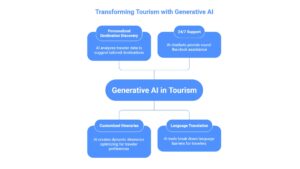
How Generative AI in Tourism is Changing: From Search to Booking
Personalized Destination Discovery and Travel Search
One of the earliest touchpoints in the travel funnel is discovering where a person might want to go. Generative AI in tourism can transform that step.
- By analyzing traveler data, such as previous trips, stated preferences, budget range, interests, and even activity history, AI can suggest destinations and experiences that match the traveler’s profile. This level of personalization increases the chances that a browsing traveler will move toward booking.
- Rather than generic suggestions or broad destination lists, generative AI in tourism can recommend places that align with what a traveler values, whether that’s adventure, culture, relaxation, eco-tourism, or luxury.
- For agencies using a platform like IV Trip, integrating AI-powered suggestions into search modules can significantly increase engagement and conversion rates.
Customized Itineraries and Travel Packages
Travelers increasingly expect more than fixed packages. They want trips that reflect their tastes, time constraints, and budgets. Generative AI in tourism enables agencies to deliver that.
- AI can build dynamic, personalized itineraries by combining flights, accommodations, activities, local transportation, and rest periods, optimizing for travel time, convenience, and preferences.
- The itineraries can include local recommendations, attractions, restaurants, cultural experiences, and hidden gems, tailored to each traveler’s interests.
- For agencies, this means offering bespoke packages at scale. What used to require manual research and custom planning can now be generated quickly, letting agents spend time refining rather than building from scratch.
24/7 Support with Virtual Assistants and Chatbots
Travel customers appreciate quick responses. Generative AI in tourism chatbots and virtual assistants is increasingly playing a role in delivering that.
- Travel companies can deploy AI-driven chatbots that respond to traveler queries in real time, about flights, hotels, visa requirements, itinerary changes, local tips, and more.
- Such chatbots can work around the clock, in multiple languages, handling common questions and support requests without requiring a large human staff.
- This kind of service enhances the customer experience, reduces response times, and allows human staff to focus on complex or high-value issues rather than repetitive tasks.
Language Translation and Localization
Tourism is global. Generative AI in tourism can help break down language and cultural barriers, helping travelers navigate foreign destinations more easily.
- AI-powered translation tools and multilingual support can allow travelers to get recommendations, communicate with local service providers, read local guides, and understand bookings even if they don’t speak the local language.
- For agencies servicing international clients or offering global travel packages, this ability expands market reach and improves accessibility. It also enhances trust and satisfaction among clients who prefer communication in their native language.
Operational Advantages for Travel Agencies: Efficiency, Cost-Savings, and Scalability
Beyond customer-facing benefits, generative AI in tourism delivers real value internally for travel agencies. It can streamline operations, reduce costs, and help agencies scale without proportionally increasing headcount.
Automating Routine and Repetitive Tasks
Many functions in travel management are repetitive, including itinerary planning, confirmation emails, bookings, follow-ups, reports, and marketing content creation, among others. Generative AI helps automate such tasks.
- AI can generate itineraries, draft marketing copy, produce promotional content, update booking information, and prepare standard communication, tasks that once required manual time and effort.
- This allows travel agents to focus on higher-value tasks: designing creative packages, nurturing client relationships, handling complex bookings, and providing personalized consultation.
- The result is faster turnaround, lower operational cost, and improved staff productivity.
Dynamic Pricing, Demand Forecasting, and Inventory Optimization
Pricing in tourism is dynamic. Demand, seasonality, events, supply constraints, and competitor pricing all affect what price travelers are willing to pay. Generative AI in tourism helps agencies navigate this complexity with more innovative pricing strategies.
- AI tools can analyze historical data, seasonal demand, events, supply levels, and external circumstances to suggest optimal pricing. This helps agencies adjust package prices dynamically to maximize revenue or offer attractive deals during low-demand periods.
- Agencies can also use AI-driven demand forecasting to anticipate booking surges or slow periods, optimizing resource allocation (inventory, staff, promotional efforts, vendor negotiations) accordingly.
- Such flexibility ensures agencies remain competitive, minimize waste (unsold packages or rooms), and increase profitability.
Marketing, Content Generation, and Virtual Tours
Effective marketing is essential in tourism. Generative AI in tourism opens up new possibilities for travel companies to scale their content creation and promotional efforts with minimal manual effort.
- AI can generate high-quality marketing content: destination descriptions, blog posts, email campaigns, social media posts, and package highlights quickly and consistently.
- AI can produce visuals, virtual tours, or 3D previews of destinations and accommodations. These immersive previews help travelers get a realistic feel for the trip before booking, reducing hesitation and boosting conversions.
- For agencies, especially in smaller markets or emerging destinations, like those using IV Trip, this ability to create polished content and visuals at low cost is a game-changer. It levels the playing field.

Challenges and Considerations: What Generative AI in Tourism Can and Cannot Do
While generative AI in tourism offers many benefits, agencies must be aware of notable challenges and limitations before fully adopting it.
Data Quality and Realism of Suggestions
Generative AI in tourism depends heavily on the quality and currency of data. If the underlying data (flight schedules, hotel availability, local restrictions, weather, events) is outdated or incomplete, AI-generated itineraries and suggestions may be inaccurate or impractical.
A system might recommend a flight schedule that no longer exists, a hotel that is sold out, or an attraction closed on certain days. That can lead to poor customer experience and loss of trust.
Therefore, human oversight remains essential, particularly for final confirmation, validation, and adjustments.
Over-Reliance on Automation, Risk of Losing Human Touch
While AI can automate many parts, travel remains a deeply human, emotional experience. Some travelers prefer personal consultation, empathy, and personalized attention, especially for complex bookings (family trips, senior travelers, group tours, special needs). Over-relying on AI might undermine the human connection and subtle customization that only a human agent can provide.
Moreover, creative or offbeat travel plans, unique experiences, cultural nuances, and local insights may require human experience that AI cannot replicate reliably.
Privacy, Trust, and Ethical Considerations
Using generative AI in tourism often involves collecting and processing personal data, such as travel history, preferences, budget, and demographics. Agencies must ensure they handle this data responsibly, transparently, and in compliance with privacy laws.
Users should consent knowingly, and agencies should maintain strong data governance, security measures, and transparency, especially when recommending personalized experiences or storing sensitive personal information.
Integration Complexity and Resource Constraints
Implementing generative AI in tourism into an existing travel agency operation, mainly if it uses legacy booking engines, multiple suppliers, local payment gateways, and manual processes, can be complex. Integration requires technical capability, time, and possibly infrastructure upgrades.
In some markets (e.g., South Asia or Bangladesh), connectivity issues, inconsistent supplier data, and limited vendor digitization may pose additional challenges.
Thus, agencies should adopt a hybrid model: use generative AI in tourism where it adds value, but retain human oversight, periodic review, and manual checks for critical steps.
The Future of Travel: CRM Software for the Travel Industry + Generative AI in Tourism
For travel agencies, especially those operating in dynamic markets like Bangladesh and South Asia, combining a powerful travel management platform with generative AI in tourism capabilities is becoming a strategic necessity.
The Role of Modern Travel Management Software
A robust travel agency software should support:
- Centralized booking, flights, hotels, tours
- Inventory management & synchronization
- Customer data management (CRM)
- Payment processing and invoicing
- Holiday and tour package design and customization
- Multi-agent and sub-agent management (for B2B or B2C operations)
- Reporting and analytics
That describes the core of IV Trip’s offering. IV Trip is designed to handle all aspects of travel agency operations: booking, package design, CRM, agent management, invoicing, payments, and more. (see IV Trip’s features on the official site). By using IV Trip, agencies can operate in a modern, scalable, and efficient way.
Where Generative AI in tourism Adds Value to IV Trip
Imagine layering generative AI on top of a system like IV Trip:
- AI-powered chatbots and virtual assistants for customer interaction, answering questions, offering destination recommendations, and guiding travelers through booking.
- AI-generated personalized itineraries and packages using traveler data stored in CRM.
- Dynamic pricing and demand forecasting for packages, helping agencies optimize pricing and inventory.
- Automated content generation, promotional materials, package descriptions, social posts, even visuals or virtual tours, enabling faster marketing and better reach.
- Multilingual support and localization, expanding reach to international travelers.
This hybrid approach, combining the structural strengths of a travel management system with the intelligence of generative AI in tourism, can give agencies a decisive competitive advantage. They can serve clients efficiently, offer personalized service at scale, and operate sustainably with fewer resource constraints.
The Future of Tourism: Trends for Agencies and What to Watch
Looking ahead, several trends suggest generative AI in tourism will play an even bigger role in shaping travel and tourism. Agencies that prepare now will be best placed to thrive.
- Multimodal AI Assistants: Emerging AI models are becoming multimodal, able to understand text, images, maps, and context. For example, research like that behind “TraveLLaMA” shows how AI can interpret urban scenes, maps, and travel queries together. This means future travel assistants may help travelers navigate cities, suggest routes, show visuals, and answer context-aware questions.
- Sustainable and Responsible Travel Planning: AI can analyze environmental data, sustainability ratings, and carbon footprint, and help craft eco-friendly itineraries. This matches rising traveler demand for sustainable tourism.
- Immersive Virtual Previews and Virtual Tours: Combining AI with 3D modeling, image generation, and VR/AR technology, agencies could offer travelers virtual previews of destinations, accommodations, or tours, reducing uncertainty and boosting confidence when booking.
- Post-Trip Personalization and Loyalty Building: AI can analyze customer feedback, behavior, and preferences after a trip to offer tailor-made suggestions for their next holiday, fostering loyalty, repeat bookings, and long-term customer relationships.
- Ethical Use, Data Privacy, and Human Oversight: As AI becomes widespread in tourism, agencies must adopt ethical practices, data governance, and maintain human oversight to ensure accuracy, fairness, and trust. Keeping a balance between automation and human empathy will be essential.
For travel agencies in Bangladesh and similar markets, adopting these trends via platforms like IV Trip could help them leapfrog traditional limitations and compete on a global scale.
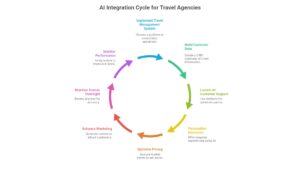
How to Get Started: A Roadmap for Travel Agencies & Tour Operators
If you run a travel agency or plan to launch one, here is a recommended roadmap to integrate generative AI in tourism into your operations using IV Trip and other tools.
- Use a robust travel management system. Choose a platform like IV Trip to consolidate bookings, CRM, inventory, payments, and package management.
- Build and centralize customer data. Maintain a CRM database of clients’ preferences, travel history, feedback, budget ranges, and demographics. This data will be essential for AI-driven personalization.
- Begin with AI-powered customer support: launch chatbots or virtual assistants to handle common queries, offer travel suggestions, and provide basic booking guidance.
- Use AI to generate personalized itineraries and package suggestions. Combine customer profile data with available inventory to offer bespoke experiences.
- Employ dynamic pricing and demand forecasting. Let AI help analyze market trends, demand patterns, and seasonal variation to optimize pricing and package availability.
- Leverage AI for marketing. Use AI to generate destination descriptions, social media content, promotional material, and even visuals or virtual tours to attract customers.
- Maintain human oversight and quality control. Always have a human agent review AI-generated plans, for practicality, accuracy, and customer suitability, especially for complex or special-need clients.
- Monitor performance and feedback. Use analytics (bookings, conversions, customer satisfaction) to measure the impact of AI tools, iterate, and improve.
By following such a roadmap, even small or medium-sized agencies can transform into modern, scalable, and efficient travel businesses ready for the future.
Generative AI in tourism isn’t just another tech trend. It’s reshaping how travelers search, plan, and book, as well as how agencies run their daily operations. When platforms like IV Trip pair solid infrastructure with AI-driven automation, agencies gain smoother workflows, happier customers, and real room to grow.
It’s not perfect—data quality, privacy, and proper oversight still matter. The most innovative approach blends AI efficiency with human judgment.
If you’re ready to move forward, reach out to Implevista for an IV Trip demo and see how AI-ready travel software can elevate your business.
FAQ: Generative AI in Tourism
What is generative AI in tourism?
Generative AI in tourism refers to using AI systems that generate new content, such as personalized travel recommendations, dynamic itineraries, chat responses, marketing copy, and virtual tours, based on data about destinations, traveler preferences, past behavior, and available services.
How does generative AI help travel booking and planning?
It enables personalized destination suggestions, bespoke itineraries, AI-driven chatbots for support, multilingual services, dynamic pricing, automated bookings and confirmations, and real-time updates, streamlining the process from search to booking and beyond.
Can a travel agency in Bangladesh use generative AI with IV Trip?
Yes. By using IV Trip for booking, inventory, CRM, and package management, combined with third-party or built-in AI tools, agencies in Bangladesh can offer modern, personalized, and efficient services to their clients.
Does generative AI replace human travel agents?
Not entirely. While AI can automate many tasks and scale personalization, human oversight remains essential, especially for complex bookings, special customer needs, quality assurance, and creative travel planning.
What are the risks or limitations of using generative AI in tourism?
Potential risks include inaccuracies due to outdated data, unrealistic recommendations, privacy concerns, reduced human empathy for exceptional cases, and integration complexity, especially with legacy systems or in regions with limited digitization.
How does AI-driven dynamic pricing work for travel agencies?
AI analyzes factors like seasonality, demand trends, supply levels, events, competitor pricing, and external conditions to suggest price adjustments for packages, accommodations, or services, maximizing revenue while offering competitive deals.
Can generative AI help with marketing and content creation for tourism?
Yes. AI can generate destination descriptions, promotional content, social media posts, email campaigns, and even visuals or virtual tour previews, at scale and quickly, reducing manual effort and cost.
Is multilingual support possible with generative AI?
Yes. AI-powered chatbots and assistants can support multiple languages and real-time translation, enabling agencies to cater to international clients, overcome language barriers, and improve user experience.
How should a travel agency implement AI without disrupting existing workflows?
Start small, integrate AI where it adds the most value (e.g., chatbots, itinerary suggestions). Maintain human review. Collect and manage customer data carefully. Use flexible, modular systems like IV Trip that allow gradual integration.
Will generative AI in tourism make travel more affordable or more expensive?
It can make travel more affordable by enabling dynamic pricing, efficient inventory use, targeted deals, cost-effective marketing, and better resource management. But final prices still depend on supply, demand, season, and service quality.